The Residential Tenancies Program has more data than we previously thought
In March 2025, Dal Legal Aid submitted a Freedom of Information Request for all emails between senior management at Service Nova Scotia and the Investment Property Owners Association of NS (now known as the Rental Housing Providers of NS).
What we received raises questions about who does and who doesn’t get access to information about renting in Nova Scotia.
UPDATE: In addition to emails published on June 18, DLAS also received emails through a FOIPOP request about legislative changes and meetings between landlord groups and Ministers and senior management at Residential Tenancies. Including conversations about the use of fixed-term leases, the abandoned Compliance and Enforcement Unit, and landlord access to legislative decision makers and information.
The full content is available to view and download below.
On March 17, 2025 - Dal Legal Aid reached out to a senior employee at Residential Tenancies looking for information on evictions ordered in Nova Scotia.
We were told: “It’s hard to say if there are an increase in eviction orders coming from the Residential Tenancies Program [...]. We do not track or collect stats to reflect any of these indicators.”
On June 9, 2025, after receiving the emails between IPOANS/RHPNS and Residential Tenancies, we reached out to the Department again to request similar statistics to ones that were sent to the landlord group.
We were told: “I cannot just provide you with information – you/DLA needs to submit a FOIPOP request. In the FOIPOP request, you can indicate what kind of information you are looking for and we will respond with what information we can extract. “
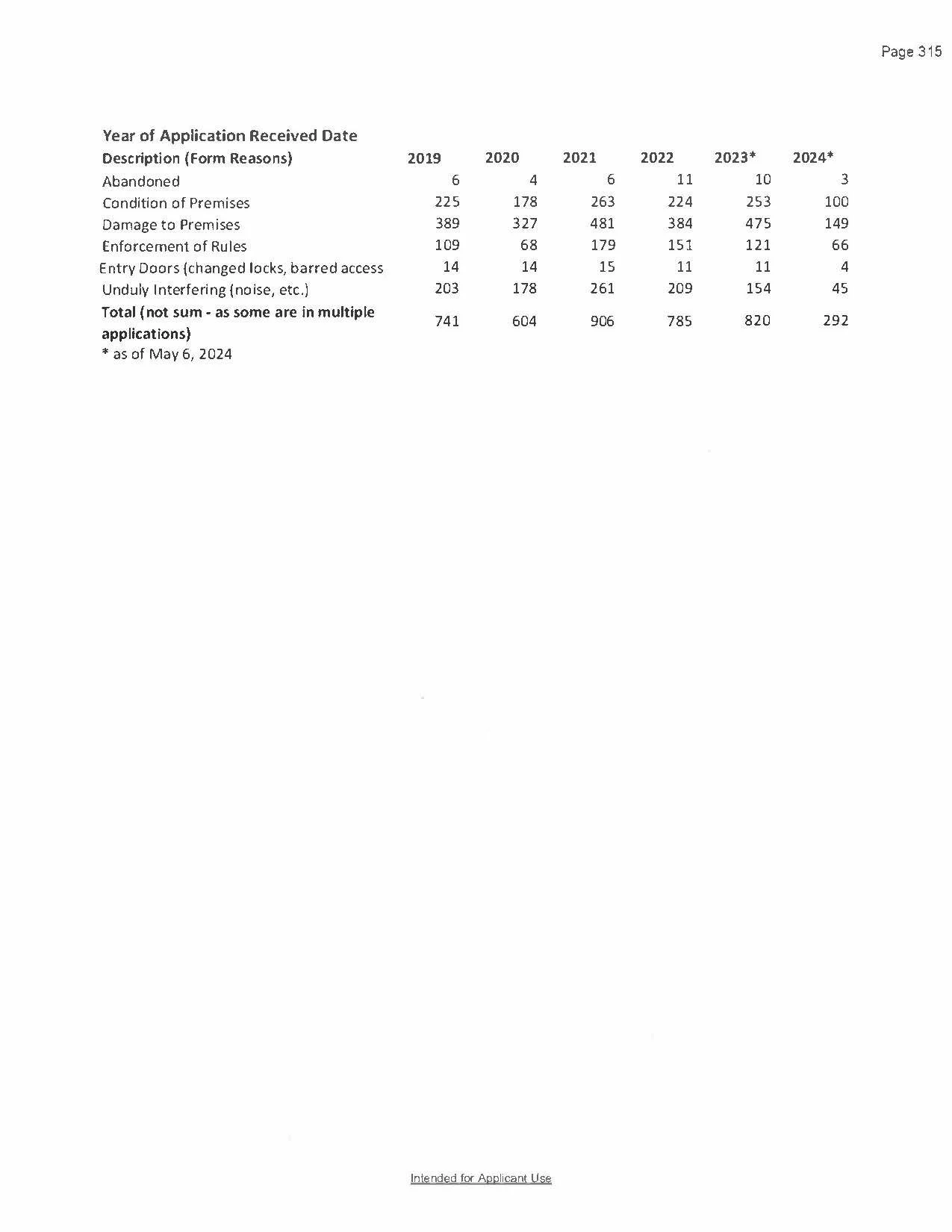
What the released emails show is that senior employees at Service Nova Scotia have sent up-to-date data and statistics from the Residential Tenancies Program to the Investment Property Owners Association of NS (now Rental Housing Providers NS) since at least 2023.
DLAS compiled our key takeaways from the data, which calls into question the reasoning behind recent legislative decisions. Please be advised that these takeaways are based on our interpretation of the data obtained, new information or clarifications from Residential Tenancies may show these interpretations to be incorrect. The full emails and data sent are available below - email correspondence with DLAS is included separately below.
Key Takeaways from the Data:
The government recently passed legislation to make evictions for rental arrears easier and faster, even though the data shows that evictions for rental arrears are down 25% since 2019.
Despite popular narratives about “problem tenants” - only 6% of landlords’ applications mention bad behaviour, 4% mention broken rules, and 13% damage to property. This doesn’t mean the tenant was found in violation or evicted - just that the application mentioned it.
Landlords make up around 70% of applications to Residential Tenancies.
Pro-tenant, anti-renoviction laws are working. Of the 358 renoviction applications in 2024, only 68 renovictions were actually granted (18%). However, we know many more renovictions happen each year - it’s essential that tenants who don’t want to move challenge their eviction at Residential Tenancies.
We are calling on the Province to regularly publish data collected from the Residential Tenancies Program.
The Department says “[they] run the numbers every Monday” - so why can’t they be made public?
We deserve a government that provides transparency for everyone - not just the rich and powerful.